

Why Choosing an EGSA-Certified Generator Technician Makes a Difference
For businesses that rely on uninterrupted power, commercial generators are mission-critical assets. However, simply owning a generator does not guarantee operational continuity. The real differentiator lies in how well that generator is maintained—and more specifically, who is maintaining it. Partnering with an EGSA-certified generator technician offers a level of assurance that non-certified providers cannot match.
The Electrical Generating Systems Association (EGSA) represents the gold standard for generator service and maintenance. Its certification program ensures that technicians meet rigorous professional benchmarks, including technical mastery, safety training, and ongoing education (EGSA Certification). As businesses adapt to evolving energy demands, prioritizing EGSA certification is not just a best practice—it is an optimization strategy that safeguards long-term reliability, safety, and ROI.
In this post, we break down four key strategies that leverage EGSA certification for generator maintenance optimization:
- Building service quality on expertise and certification.
- Reducing downtime through precision diagnostics.
- Extending reliability and equipment life with preventive care.
- Ensuring safety, compliance, and tailored solutions.
Strategy 1: Expertise & Certification as a Foundation of Service
Certification is more than a credential—it is a framework for professional excellence. EGSA certification requires technicians to pass comprehensive exams covering generator set engines, alternators, electrical systems, and automatic transfer switches. Crucially, it is not a one-time milestone; recertification and continuous education are mandatory. As EGSA itself notes, the program “serves as an impartial, third-party endorsement of your knowledge and experience on a national level” (EGSA Certification FAQs).
Companies like Duthie Power invest in their Technicians’ certification, paying for preparation courses, exams, and on-site study sessions. “We’ve been steadily investing in EGSA certification for our team of generator technicians,” says Johnny Bradford, Duthie Power’s Service Manager. “We pay for the test prep and examination, in addition to facilitating on-site review sessions that enable our team to study and support each other.” This culture of investment fosters consistency, professionalism, and trust. When your provider prioritizes certification, you gain a service partner who values the same operational reliability that your business depends on.
This translates into tangible benefits for businesses. By choosing EGSA-certified technicians, facility managers are assured that the professionals working on their critical power systems have achieved measurable competence recognized across the industry.

Why Certification Matters
- EGSA certification = national benchmark of generator expertise.
- Requires ongoing education, not just initial training.
- Demonstrates credibility and professionalism.
- Providers who invest in certification deliver higher consistency.
Strategy 2: Reducing Downtime Through Precision Diagnostics
In the commercial world, generator downtime is costly. Every hour of outage can represent thousands of dollars in lost productivity. EGSA-certified technicians reduce these risks by diagnosing issues swiftly and accurately. Unlike trial-and-error troubleshooting, certified technicians apply structured diagnostic frameworks backed by formal training.
Generator Source highlights this point: “EGSA-certified technicians deliver exceptional, hands-on expertise that our customers rely on” (Generator Source). By pinpointing problems the first time, businesses avoid costly repeat visits and unnecessary delays.
Peer-reviewed research underscores this connection. Marqusee (2020), in a National Renewable Energy Laboratory (NREL) study, found that “a poorly-maintained [emergency diesel generator] is unlikely to provide power for durations longer than a few days and has a reliability of only 80% at 12 hours” (NREL Report 76553). This illustrates the financial and operational stakes of relying on substandard maintenance.
Complex generator systems—such as dual-fuel models, parallel configurations, and advanced controllers—demand specialized diagnostic skill. EGSA-certified technicians are equipped to interpret system data correctly and expedite recovery.
Commercial generators can also vary widely in size, design, and application. “One of the things that makes my job easier,” says Julie Bonventre, Duthie Power Sales Engineer, “is that I rarely have to say No to a customer. Our technicians, EGSA-certified or not, have the expertise and experience to work on a range of generator makes, models, and components.”
Downtime Reduction Benefits
- Swift, accurate diagnostics minimize downtime.
- Reduces repair costs and repeat service calls.
- Certified expertise handles advanced system complexities.
- Direct financial savings from avoided downtime losses.
Strategy 3: Improving Reliability & Extending Equipment Life
Generators are significant capital investments designed to last for years under demanding conditions. Optimizing their lifespan requires a proactive, preventive maintenance approach. EGSA-certified technicians are trained in industry best practices to spot early warning signs before they escalate into costly breakdowns.
When equipment performs reliably, businesses avoid unplanned outages and ensure critical systems—from hospitals to data centers—operate seamlessly during emergencies. Over time, extended lifespan equates to lower total cost of ownership.

Reliability & Lifespan Gains
- Preventive maintenance avoids catastrophic failures.
- Certified inspections catch wear before it escalates.
- Extends generator lifespan and lowers lifecycle costs.
- Greater reliability during critical power needs.
Strategy 4: Ensuring Safety, Compliance & Tailored Solutions
Commercial generators involve high voltages, combustible fuels, and complex transfer systems. Improper maintenance not only threatens uptime but also creates severe safety hazards. EGSA-certified technicians are rigorously trained in safety standards and compliance protocols, protecting both employees and assets.
“Safety is our top priority at Duthie Power,” says Johnny Bradford, Duthie Power Service Manager, “and safety and reliability go hand in hand. We hold our team to pretty high safety standards that, in turn, keep our customers’ equipment running smoothly for years.”
Furthermore, certified technicians excel at tailoring solutions to specific applications. Whether your facility operates a small backup generator or a large prime power system, customization is key. Factors like load demand, operating environment, and regulatory requirements must all be considered. EGSA-certified professionals can design maintenance plans that reflect these unique variables.
Safety and compliance are also legally binding in many industries. Regulatory non-compliance can trigger fines, legal action, or insurance issues. EGSA certification ensures that technicians understand the evolving standards and apply them consistently.
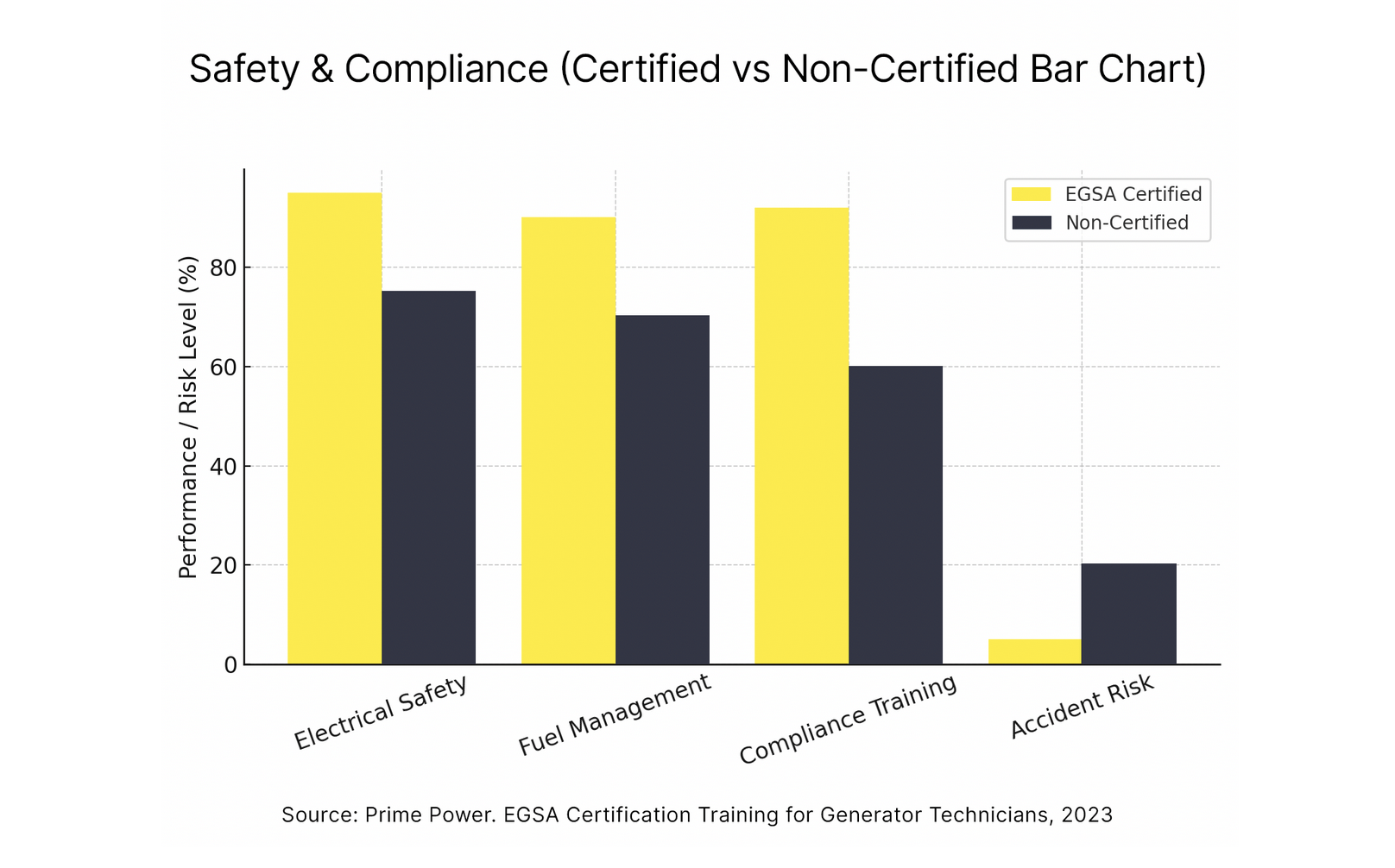
Safety & Tailoring Advantages
- Strict safety and compliance adherence lowers liability.
- Reduced risk of accidents, fines, and legal issues.
- Custom maintenance plans fit specific environments.
- Optimized performance across all generator types.
Final Thoughts
For mission-critical operations, generator performance is not negotiable. The difference between an average maintenance program and an optimized one lies in who is servicing your equipment. An EGSA-certified generator technician delivers unmatched expertise, precision, reliability, and safety.
By adopting the four strategies outlined—expertise as a foundation, precision diagnostics for reduced downtime, proactive care for equipment longevity, and certified safety with tailored solutions—businesses maximize uptime, protect investments, and safeguard their bottom line.
“Investing in EGSA certification has been worth every penny,” says Randy Gross, Duthie Power’s Director of Operations. “The long-term benefits outweigh the initial expense and time investment. And better maintenance translates to fewer breakdowns, lower repair costs, and extended equipment life. Over time, the savings from reduced downtime and more efficient operations lead to a stronger return on investment for your generator system and for our company.”
Academic research confirms the stakes: poorly maintained systems are significantly less reliable, while structured maintenance ensures resilience. With certified technicians, you transform generator maintenance from a reactive expense into a proactive investment in reliability and continuity.
When the power goes out, your organization cannot afford uncertainty. With EGSA-certified professionals, you gain the confidence that your systems will perform when they are needed most.


